TOTPRadius VPN Portal - Security
Last updated 2026-10-21
Security notice: PHP vulnerabilities (October 2026)
Published 2026-10-21
On 21 October 2026 the PHP project disclosed two critical vulnerabilities, CVE-2026-109618 and CVE-2026-109619 (CVSS 9.2). Under certain conditions, they could let an unauthenticated attacker run code on a server through crafted HTTP requests.
Exposing the TOTPRadius VPN Portal directly to the public Internet is now discouraged.
If your VPN Portal is published via NAT with "Allowed remote IPs" set to "Any", we recommend the following:
- Remove the public NAT rule if you don't need the portal's features (FIDO2/Passwordless, OAuth2/SSO, self-service enrollment).
- Otherwise, restrict access to known source IP ranges or countries, or publish the portal only through a reverse proxy or WAF that limits request size and blocks
multipart/form-datarequests. - Never expose the admin interface (ports 22, 80, 443) to the Internet.
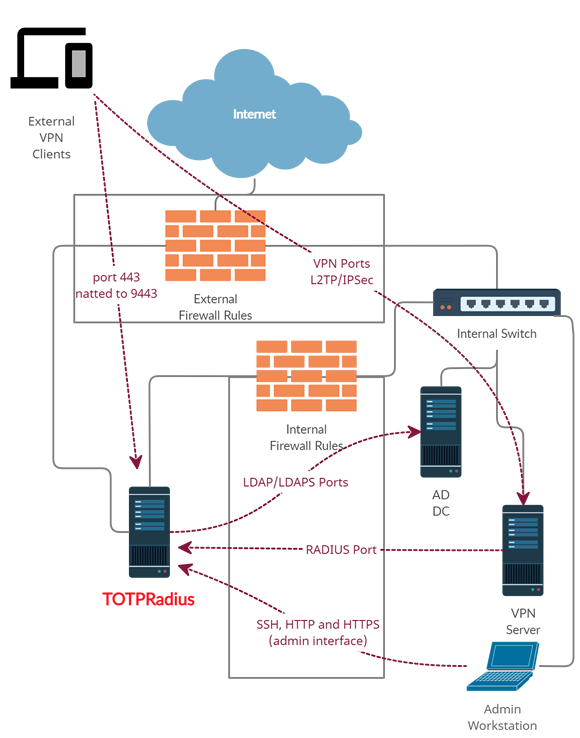
Standard deployments without the VPN Portal, with management access limited to admin workstations as shown above, are not exposed.
An updated appliance image will be announced later. For help reviewing your setup, contact our support team.
The principle behind VPN Portal is that it has to be accessible from the public internet, so there is an additional configuration required in your network layout. The web portal is running as a separate web server on the same virtual appliance, instead of standard https port (443) used for admin interface, the VPN web portal responds on port 9443. This port cannot be used directly for technical reasons, so has to be NATted to port 443.
The recommended network layout is displayed below
Approved Security Label
For obvious reasons, this portal has to be exposed to the public network. We understand the potential risks and hesitations of making a web application accessible to the whole planet, therefore to ensure the security of the VPN Portal is at the highest level, we have contracted an independent security company, SySS GmbH , to conduct a full penetration testing against this web application and produce a report.
The team from SySS GmbH has completed the penetration testing and produced a security certificate available below:
The TOTPRadius VPN Portal component is currently labeled as "Certified Website - Approved Security" by SySS Gmbh
